FAQ on ISO 42001 Certification
Artificial intelligence is rapidly changing the world of work. More and more companies are using ChatGPT, Microsoft Copilot, AI assistants, automated analyses, or AI-powered processes. At the same time, requirements for data protection, transparency, compliance, and risk management are increasing. This is exactly where ISO 42001 certification comes in. The norm is considered the world’s first standard for AI management systems and helps companies use artificial intelligence in a structured, secure, and responsible manner. In this article, we answer the most important questions regarding ISO 42001 certification.
What is ISO 42001 certification?
ISO 42001 certification confirms that a company uses artificial intelligence systematically, in a controlled manner, and responsibly.
ISO 42001 is an international standard for AI management systems. It defines requirements for how companies plan, evaluate, monitor, and continuously improve AI applications.
Similar to ISO 9001 for quality management or ISO 27001 for information security, the standard creates a structured framework for dealing with artificial intelligence.
Successful certification shows customers, partners, and authorities that AI is not used in an uncontrolled manner but follows clear rules and processes.
Why was ISO 42001 developed in the first place?
ISO 42001 was developed because companies are increasingly using AI, which creates new risks.
AI can create enormous benefits. At the same time, new challenges arise:
- AI hallucinations
- Data protection risks
- Discrimination and bias
- Lack of transparency
- Copyright issues
- Unclear responsibilities
ISO 42001 was developed to provide companies with a framework to manage these risks.
What are the benefits of ISO 42001 certification?
ISO 42001 certification builds trust, reduces risks, and improves the management of AI applications.
It offers companies several advantages:
- Proof of professional AI management
- Better control over AI applications
- Greater legal certainty
- Preparation for regulatory requirements
- Increased trust among customers and business partners
- Competitive advantages in tenders
Companies that process sensitive data or use AI in customer processes particularly benefit from structured governance.
Do small companies even need ISO 42001 certification?
Certification is not mandatory, but it is very useful if companies use artificial intelligence regularly.
Many managing directors believe the standard is only intended for large corporations. In fact, even small companies are already using AI in numerous areas:
- Marketing
- Sales
- Customer service
- Software development
- knowledge management
- Document creation
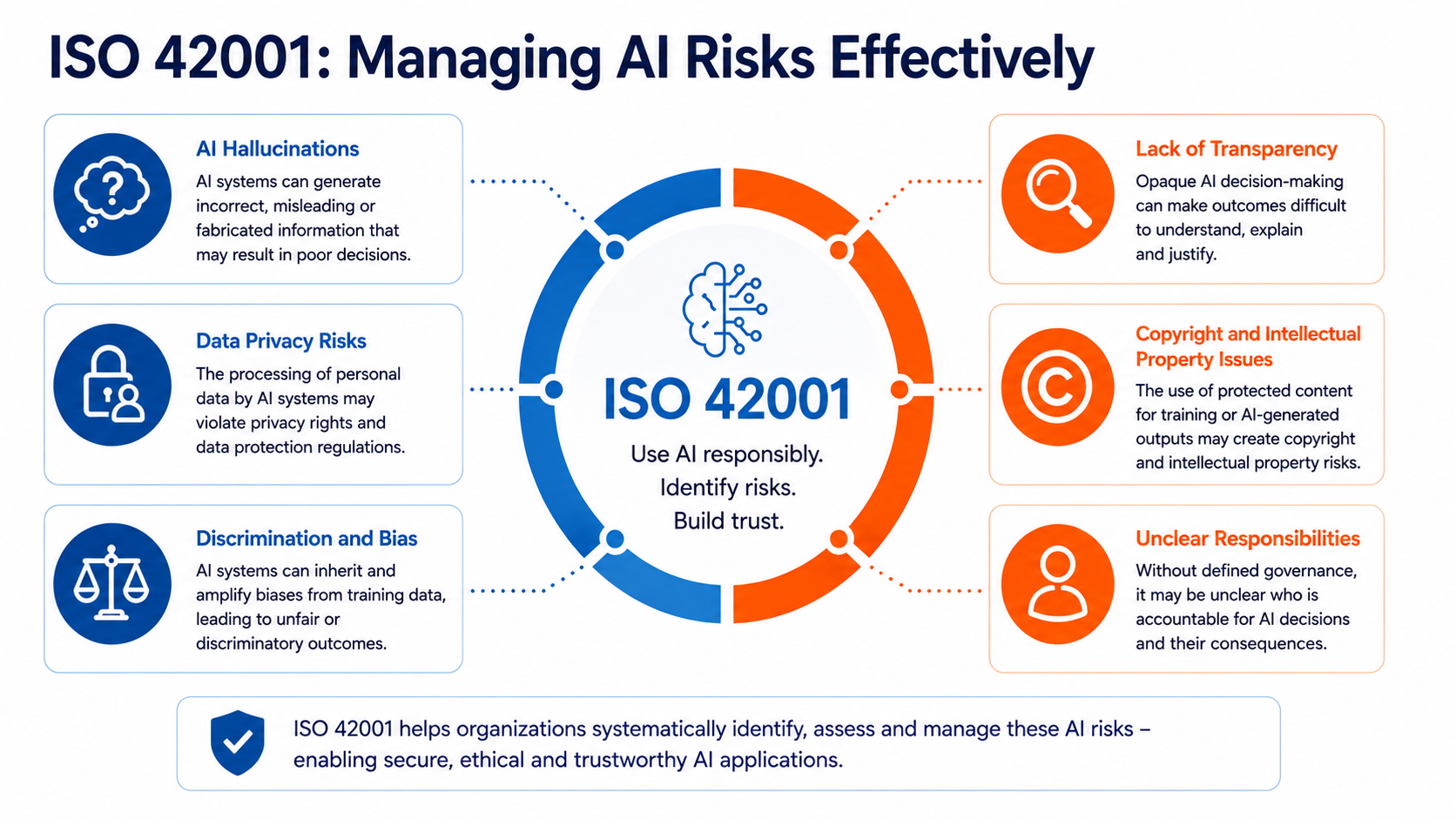
The more AI is integrated into business processes, the more important a systematic approach to opportunities and risks becomes. The infographic below highlights some of the most important risks associated with the use of artificial intelligence in organizations, including AI hallucinations, data protection concerns, bias and discrimination, lack of transparency, copyright issues, and unclear responsibilities. ISO 42001 helps companies systematically identify, assess, monitor, and mitigate these risks, ensuring that AI is used responsibly, transparently, and effectively.
We don’t develop AI. Do we still need the standard?
In many cases, yes. ISO 42001 is not only aimed at companies that develop their own AI systems. Companies that use ready-made AI solutions can also benefit from the standard.
Typical examples:
- ChatGPT
- Microsoft Copilot
- Claude
- Gemini
- Midjourney
- AI functions in CRM or ERP systems
The crucial question is not: “Do we develop AI?”
But rather: “Do we use AI for business?”
If the answer is “yes,” the standard may be relevant to your company.
What is the difference between ISO 42001 and ISO 27001?
ISO 27001 schützt Informationen. ISO 42001 steuert den Einsatz von KI.
Die ISO 27001 Zertifizierung konzentriert sich auf Informationssicherheit.
Typical questions of ISO 27001:
- Is data protected?
- Is access controlled?
- Are security risks managed?
ISO 42001 goes much further.
Typical questions of ISO 42001:
- Which AI systems are being used?
- What risks arise?
- Who bears responsibility?
- How are results monitored?
- How are wrong decisions prevented?
Many companies combine both standards.
How much does ISO 42001 certification cost?
The costs of ISO 42001 certification depend on the size of the company, the complexity of the AI applications used, and the chosen certification model. However, digital and AI-supported approaches can significantly reduce effort and costs today.
The costs of ISO 42001 certification typically consist of several components:
- Setting up the AI management system
- Creation of the required documentation
- Employee training
- Conducting internal audits
- Certification audit
- Annual surveillance audits
Traditionally, companies are often supported by consultants who manually create guidelines, processes, and evidence. This can involve significant time and expense.
With our digital certification approach, this process is significantly faster. Through our online platform, companies are guided step-by-step through the requirements of ISO 42001. The required documentation is created with AI support and adapted to the company’s individual situation. This often reduces the effort from several weeks or months to just a few hours.
However, when considering costs, companies should not only look at the investment but also at the benefits:
- Greater legal certainty when using AI
- Better control over AI applications
- Reduction of compliance and liability risks
- Increased trust among customers and business partners
- Competitive advantages in tenders and sales processes
- Preparation for future regulatory requirements such as the EU AI Act
An exact calculation depends on the company’s individual starting situation. However, thanks to digital certification models and AI-supported documentation, costs today are significantly lower than for traditional consulting and certification projects. This makes ISO 42001 certification economically attractive for small and medium-sized enterprises for the first time.
What do I need to do for ISO 42001 certification?
You must set up an AI management system and demonstrate that you manage AI systematically.
Typically, the path to certification includes:
- Identifying AI applications
- Assessing risks
- Assigning responsibilities
- Creating guidelines
- Training employees
- Defining controls
- Conducting audits
- Creating a management review
You can find a detailed step-by-step guide in our article on setting up an ISO 42001 management system.
Is ISO 42001 important because of the EU AI Act?
Yes, the standard can support companies in implementing regulatory requirements. The EU AI Act creates the first Europe-wide rules for artificial intelligence.
In the future, companies will have to provide stronger evidence of:
- which AI systems they use
- what risks exist
- what protective measures have been implemented
Although ISO 42001 is not a legal requirement, it provides a recognized framework for systematically implementing many requirements. In our article on ISO 42001 certification, you will find a comparison of the requirements of the EU AI Act and ISO 42001 certification.
Is ISO 42001 certification worth it today?
Yes, for many companies, especially if AI is already being used productively.
The development is similar to earlier standards such as ISO 9001 or ISO 27001. Initially, they were used by a few pioneers. Later, they were increasingly demanded by customers, partners, and tenders.
Companies that rely on ISO 42001 today can:
- Gain experience
- Establish processes
- Build trust
- Stay ahead of regulatory developments
Especially for technology-oriented companies, this can be an important competitive advantage.
More Posts
Is ISO certification still up to date? Anyone looking for a new business partner today [...]
What is actually changing in ISO 14001:2026? ISO 14001:2026 does not radically tighten environmental management, [...]
How long does ISO 27001 certification take? In the past, a traditional ISO 27001 [...]
ISO 9001: The three major misconceptions ISO 9001 is often misunderstood. Learn how to avoid [...]


