
What is ISO 9001:2026? An easy-to-understand introduction
ISO 9001:2026 explained in brief
ISO 9001:2026 is a management system that enables companies to align their products and services with customer needs. This increases the number of new customer inquiries and their revenue. By defining clear business processes and continuous improvement, they increase their competitiveness and offer their customers improved services. Companies that can demonstrate ISO 9001 certification enjoy a head start in trust with business partners. They grow significantly faster than their competitors.
Until now, certification to ISO 9001 has been associated with a great deal of time and effort: consultants and auditors came on site, and creating the documentation sometimes took months. Small companies in areas such as services, retail, or consulting were often overwhelmed by this. However, digitalization and the use of artificial intelligence are making this increasingly easier. The Digital Institute for Certification of International Standards (DICIS AG) therefore offers simple and affordable online certification.
What are the benefits of ISO 9001 certification?
Certification to ISO 9001:2026 offers companies and organizations—including small businesses—numerous benefits.
What are the requirements of ISO 9001:2026?
You must clearly define and document your workflows so that everyone knows what to do. You must also regularly check whether everything is working and improve your company step by step. ISO 9001:2026 sets out the principles and requirements that companies must follow if they want to establish a quality management system and achieve conformity with the standard. The requirements are explained in this article.
For many companies, it is a challenge that ISO 9001:2026 leaves a wide scope for interpretation in implementation. For example, customer focus is a clear requirement, but there are no rules on how customer feedback should be collected, analyzed, and measured.
With the revision of the standard in 2026 (hence the name ISO 9001:2026), the International Organization for Standardization (ISO) has taken an important step toward flexibility: unlike earlier versions, the standard is intended to be easy to apply for all companies and self-employed professionals.
The 2026 revision of ISO 9001 moves even more strongly toward strategy and corporate culture and pushes pure formalism further into the background. This continues the consistent path that ISO already set with the 2015 version.
This also allows for the option of digital ISO 9001 certification. The Digital Institute for Certification of International Standards (DICIS) offers a particularly innovative process. Supported by an AI assistant, you develop your entire documentation online. After a certification audit, you receive your first certificate. This enables you to show your customers in the shortest possible time that you meet the requirements of ISO 9001:2026.
How is ISO 9001:2026 structured?
The standard has 10 chapters; the requirements begin in Chapter 4 and comprise a total of 28 subclauses.
ISO 9001 is clearly structured. The first three chapters contain the introduction and terms. From Chapter 4 onward, the actual requirements that companies must implement begin.
The key contents are:
Overall, this results in around 28 subclauses with specific requirements for your company.
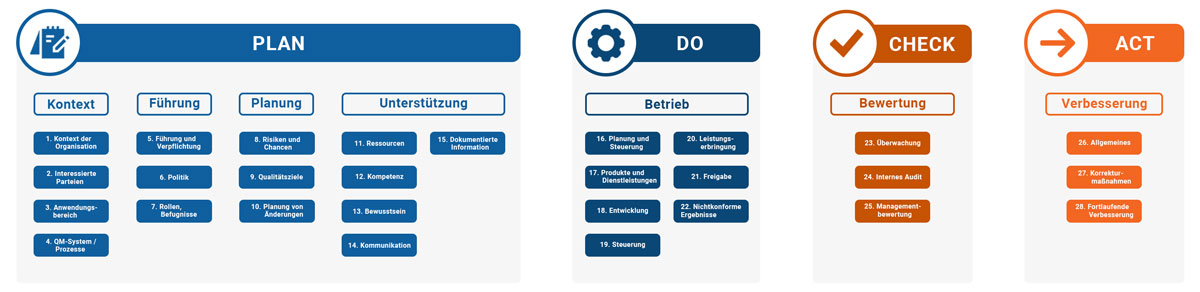
ISO 9001 overview
Broadly speaking, the standard can be divided into four areas:
With digital ISO 9001 certification, you can implement all of these requirements conveniently online. Once you have developed your documentation and implemented the requirements, you will receive your certificate.
Clause 4.1: Which internal and external issues must I consider?
You must clearly define and document your workflows so that everyone knows what to do. You must also regularly check whether everything is working and improve your company step by step. ISO 9001:2026 sets out the principles and requirements that companies must follow if they want to establish a quality management system and achieve conformity with the standard. The requirements are explained in this article.
You must understand what is happening within and around your company. This includes internal issues (e.g., workflows, employees) and external issues (e.g., market, competition). In short: understand what influences your business.
Imagine you are the pilot of an aircraft. What influences your goal of getting safely from A to B? The weather report and route information, but also the aircraft owner’s requirements, legal regulations, cabin crew training, and much more.
That is exactly what ISO 9001 requires: you should address all issues that are important for your company, your site, your department, or a specific workflow in the company so that you can achieve your objectives. What is the general economic situation? Which legal requirements are relevant? Which new technologies must we consider? Which internal issues influence success?
With the revision of the standard in 2026 (hence the name ISO 9001:2026), the International Organization for Standardization (ISO) has taken an important step toward flexibility: unlike earlier versions, the standard is intended to be easy to apply for all companies and self-employed professionals.
The 2026 revision of ISO 9001 moves even more strongly toward strategy and corporate culture and pushes pure formalism further into the background. This continues the consistent path that ISO already set with the 2015 version.
This also allows for the option of digital ISO 9001 certification. The Digital Institute for Certification of International Standards (DICIS) offers a particularly innovative process. Supported by an AI assistant, you develop your entire documentation online. After a certification audit, you receive your first certificate. This enables you to show your customers in the shortest possible time that you meet the requirements of ISO 9001:2026.
Who are “interested parties” in Clause 4.2?
You must clearly define and document your workflows so that everyone knows what to do. You must also regularly check whether everything is working and improve your company step by step. ISO 9001:2026 sets out the principles and requirements that companies must follow if they want to establish a quality management system and achieve conformity with the standard. The requirements are explained in this article.
You must determine who has expectations of your company—especially customers. You should know and take these requirements into account. In short: know what others expect from you.
No company, organization, or site operates in isolation. There are relationships with partners and suppliers, employees, shareholders, authorities, and of course customers. ISO 9001 requires companies to understand the expectations of these different parties and act accordingly. (Clause 4.2)
The graphic shows how different stakeholder groups influence a company or organization. It is important to address these—often differing—interests and be aware of the inherent tensions. By the way, ISO 9001 does not require negotiating a compromise between all of these stakeholder groups; that is a common misunderstanding. It is about making conscious decisions when certain interests are neglected. (For example, lower profits for owners as a result of investments in staff.)
With the revision of the standard in 2026 (hence the name ISO 9001:2026), the International Organization for Standardization (ISO) has taken an important step toward flexibility: unlike earlier versions, the standard is intended to be easy to apply for all companies and self-employed professionals.
The 2026 revision of ISO 9001 moves even more strongly toward strategy and corporate culture and pushes pure formalism further into the background. This continues the consistent path that ISO already set with the 2015 version.
This also allows for the option of digital ISO 9001 certification. The Digital Institute for Certification of International Standards (DICIS) offers a particularly innovative process. Supported by an AI assistant, you develop your entire documentation online. After a certification audit, you receive your first certificate. This enables you to show your customers in the shortest possible time that you meet the requirements of ISO 9001:2026.
What requirements does ISO 9001 set for customer focus?
You must clearly understand your customers’ requirements, meet them reliably, and regularly check whether your customers are satisfied—and respond quickly if problems arise.
The standard also indicates who is responsible for this: a company’s leadership. As with many aspects of the standard, the wording in ISO 9001:2026 leaves considerable room for interpretation. It does not prescribe which specific leadership tasks are involved. Instead, there are requirements that companies must interpret differently. Depending on how one personally views these degrees of freedom, this is either the problem or the appeal of the standard.
Do I really have to document all processes?
No, you do not have to document all processes. ISO 9001 requires only the processes you truly need to achieve your objectives and manage your company. In small companies, these are usually only a few core workflows—often 2 to a maximum of 5 processes.
Alongside customer focus, the process approach is one of the cornerstones of ISO 9001:2026. The standard states in 0.3.1: “
As with much of the standard, this sentence can feel cumbersome on first reading. Therefore, here are the principles it refers to in brief:
Clause 6.1: How detailed do I need to document risks?
You must clearly define and document your workflows so that everyone knows what to do. You must also regularly check whether everything is working and improve your company step by step. ISO 9001:2026 sets out the principles and requirements that companies must follow if they want to establish a quality management system and achieve conformity with the standard. The requirements are explained in this article.
You do not need to document risks in a detailed or complicated way. It is sufficient to consider what could go wrong in your company and note it briefly. The other side is also important: opportunities. Every risk contains the possibility to improve workflows.
Clause 0.3.3 states: “Risk-based thinking is essential for achieving an effective quality management system.” Companies must analyze and assess opportunities as well as risks in everything they do. This can be done, for example, through a risk management.
This does not mean that companies are generally not allowed to take risks. After all, entrepreneurship consists of risks. However, when establishing a management system in accordance with ISO 9001:2026, it is important to ensure a balance between opportunities and risks.
The principle and requirement of risk-based thinking is intended to prevent companies from focusing heavily on potential opportunities while neglecting risks.
Accordingly, the standard states: “Addressing both risks and opportunities provides a basis for increasing the effectiveness of the quality management system.”
Additional content and requirements of ISO 9001:2026
ISO 9001:2026 also sets further requirements regarding competence (Clause 7.2), awareness (Clause 7.3), and communication (Clause 7.4).
ISO 9001: Which documents are mandatory?
Mandatory documents include quality objectives, the quality policy, the scope, and results from audits and management reviews. In addition, it is advisable to document processes, responsibilities, and internal and external issues. This is not mandatory, but it helps create clarity and makes your company easier to manage.
ISO 9001:2026 does not require companies to turn into bureaucratic monsters. Clause 7.5.1 explicitly states: “The extent of documented information for quality management systems can differ from one organization to another due to:”
This is where the already mentioned scope for interpretation in the standard exists. Information must be documented, but it does not necessarily require writing novels. Sometimes bullet points or short descriptions are sufficient.
Ultimately, documented information under ISO 9001:2026 is not intended to meet the needs of a certification body, but to enable a company to improve.
When you read through the requirements, you quickly come to the conclusion: “We already do all of this.” Clause 7.5 (documented information) contains its own guidelines, which we summarize in the article Document control. Essentially, this means that all information related to the creation and maintenance of a quality management system must be documented in writing. In the past, there was the so-called “quality management manual.” This is no longer required. Especially thanks to the possibilities of digitalization, there are various new options, such as software solutions.
Is ISO 9001 certification mandatory?
No, ISO 9001 certification is generally voluntary. It is not required by law. However, many customers require certification as a prerequisite for working together. Without a certificate, it may therefore be more difficult to win new contracts or serve larger customers.
As a management system, ISO 9001:2026 is voluntary. No company can be forced to submit to the principles of this standard. There are also no prescribed procedures for ISO 9001 certification. (Exceptions may exist in particularly regulated and, for example, safety-critical industries.) Customers can also make awarding a contract dependent on the presence of ISO 9001:2026 certification. However, this is then a voluntary decision by the awarding organization and does not constitute an obligation.
With ISO 9001 certification, companies demonstrate reliability and a high standard of meeting customer needs to their customers. The certificate and the existence of a quality management system send a signal of trust to the market and are therefore a major competitive advantage for companies. Sending this signal of trust is the greatest benefit of ISO 9001:2026.


