What is a Management System? Introduction and Overview
Management systems distinguish professional companies from those where things happen by chance and on an ad-hoc basis.
The introduction of management systems is based on various motives:
The most well-known management systems include ISO 9001:2026 (quality management system), ISO 14001 (environmental management), and ISO 27001 (information security management system). These management systems can be the subject of an ISO certification.
What types of management systems are there?
There are various management systems, depending on the objective. The best known are quality management (ISO 9001), environmental management (ISO 14001), and information security management (ISO 27001). They help companies improve processes, meet environmental requirements, and protect data.
A management system helps you organize your company better. There are different types depending on what is important to you. Most small businesses start with one system and expand it later.
The most important management systems are:
For small businesses: You don’t have to do everything at once. Often, it’s enough to start with one system. As your company grows, you can add further areas.
Ultimately, it’s always about making your company simpler, clearer, and more secure.
Do I, as a small business, even need a management system?
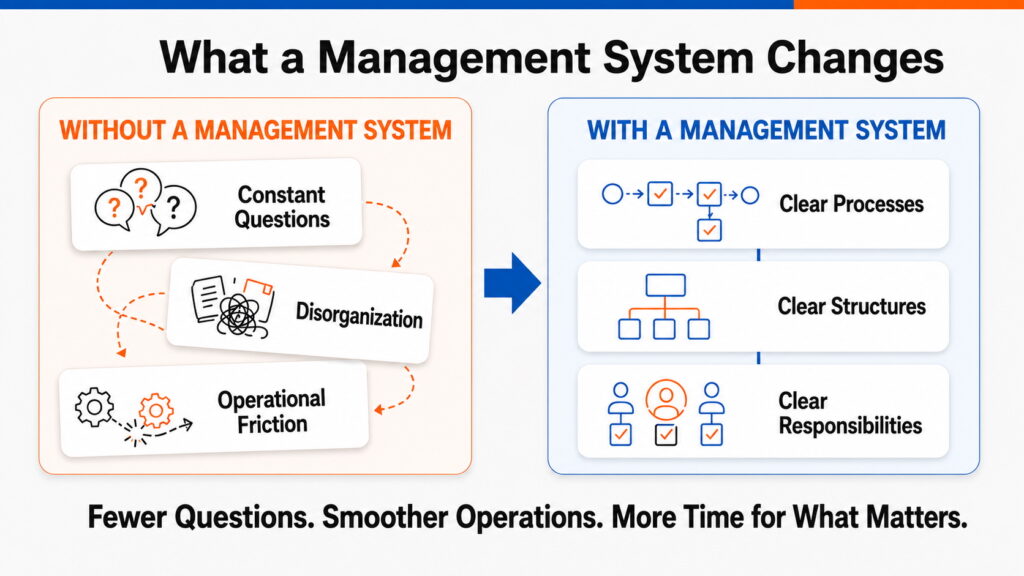
Yes, even small businesses benefit from clear processes, fewer errors, and better organization. The development of management systems is based on a rather simple philosophy: to create a mechanism that allows companies to reliably carry out tasks important for business success and to continuously improve. Read our article on the ISO 9001 philosophy for more information.
 Management systems are tools for managing complexity. It’s about setting goals, considering the framework conditions, deriving actions and measures from these goals, and reliably completing tasks through clear processes and responsibilities.
Example Quality Management: To consistently deliver high quality in all areas of a company, measures are required that affect all areas – from top management to apprentices. A quality management system therefore intensively deals with the four phases of the PDCA cycle: Plan, Do, Check, Act.

Plan: Measures for corporate planning
Company activities do not arise spontaneously or due to individual customer inquiries, but are carefully planned. Planning is the largest and most important part of the ISO 9001:2015 quality management system. For example, if all core processes of a company are to be documented according to the principles of document control, this simply means that the company plans what processes it needs to achieve its goals.
Do: Execution of planned activities
The philosophy behind management systems is that the execution of planned activities occurs (almost) independently of individuals. If all necessary measures and business processes are defined, if responsibilities are assigned, and key performance indicators are set, then – in theory – tasks are completed almost automatically. This is not always the case in practice, but it is the ideal state that companies strive for by implementing a management system.
Check: Verify if goals have been achieved
The philosophy behind management systems is that everything is measurable. Has sales achieved its targets? This can be measured, for example, by the number of customer meetings, the closing rate, or the value of newly acquired orders. The results of supplier audits or the satisfaction of customers with a company’s products, offers, and services are also measurable. This is an important component of management systems: success is not left to chance but is measured.

Act: Continuously improve
Any deviation between “target and actual” in management systems is not an error, but a deviation that can be optimized. Accordingly, continuous improvement is an important part of a management system. It’s about companies constantly asking themselves, down to small, detailed processes: Is it optimal?
This logic, explained using a quality management system as an example, can be applied to practically all other management systems, regardless of whether it concerns sustainability management, energy management, risk management, or information security management. At its core, it is always about the same thing: planning activities, executing them, checking key figures, and systematically improving.
To put it another way: if you understand the core of one management system, you understand 70 to 80 percent of all management systems. At the ISO this is called the “High Level Structure.”
To make management systems more accessible, especially for small and medium-sized enterprises, the organization has agreed to give its management systems fundamentally the same structure. This makes it significantly easier for a company that has, for example, implemented a quality management system according to ISO 9001:2015 to introduce another one, for example, on sustainability, energy management, or information security.
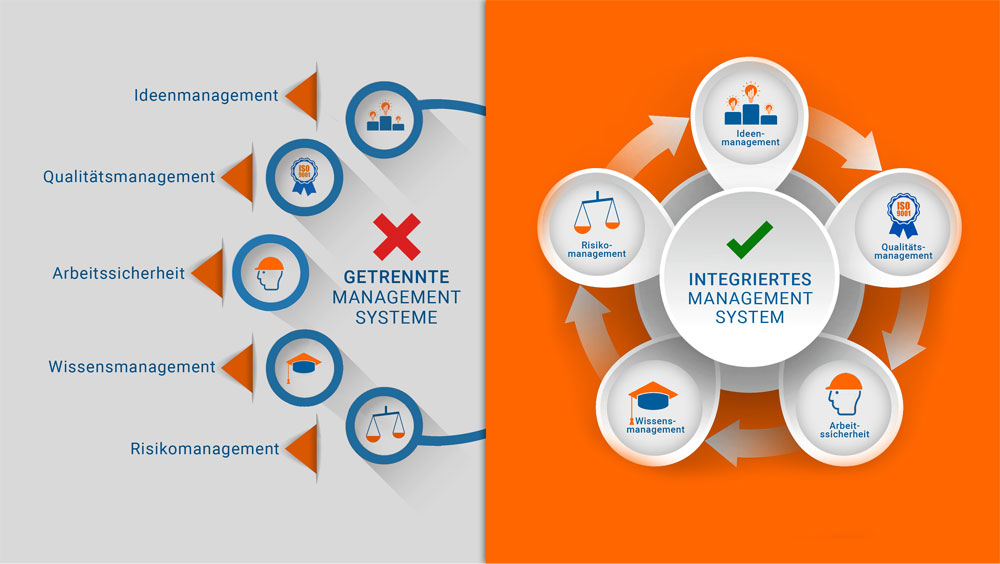
To prevent these management systems from existing side-by-side, the concept of an integrated management system was introduced.
What are the benefits of an integrated
management system?
An integrated management system ensures that your company is organized more clearly and simply. Instead of using multiple systems, you have everything in one place. This saves time, reduces errors, and helps you maintain an overview – even without additional employees or consultants.
An integrated management system means you manage your company with a clear, simple system. All important topics – for example, quality, environment, or IT security – converge. You don’t have to create separate rules or documents for each topic.
This particularly helps small businesses. They often have little time and no dedicated specialists. With an integrated system, you avoid duplicate work. You always know who does what and how processes work.
This specifically provides you with:
An integrated management system doesn’t make your company more complicated – it makes it simpler. You maintain an overview and can focus more on your business.