AI Failures Always Happen to Others. Until They Don’t.
AI failures don’t just happen to others. They happen to global corporations, experienced managers—and potentially to your company. AI promises faster processes, higher productivity, and entirely new business models. But there is a catch: the faster companies deploy AI, the greater the risk of costly mistakes, data leaks, legal consequences, and reputational damage. In this article, you’ll discover real-world AI failures, why they happened, and how your company can avoid making the same mistakes.
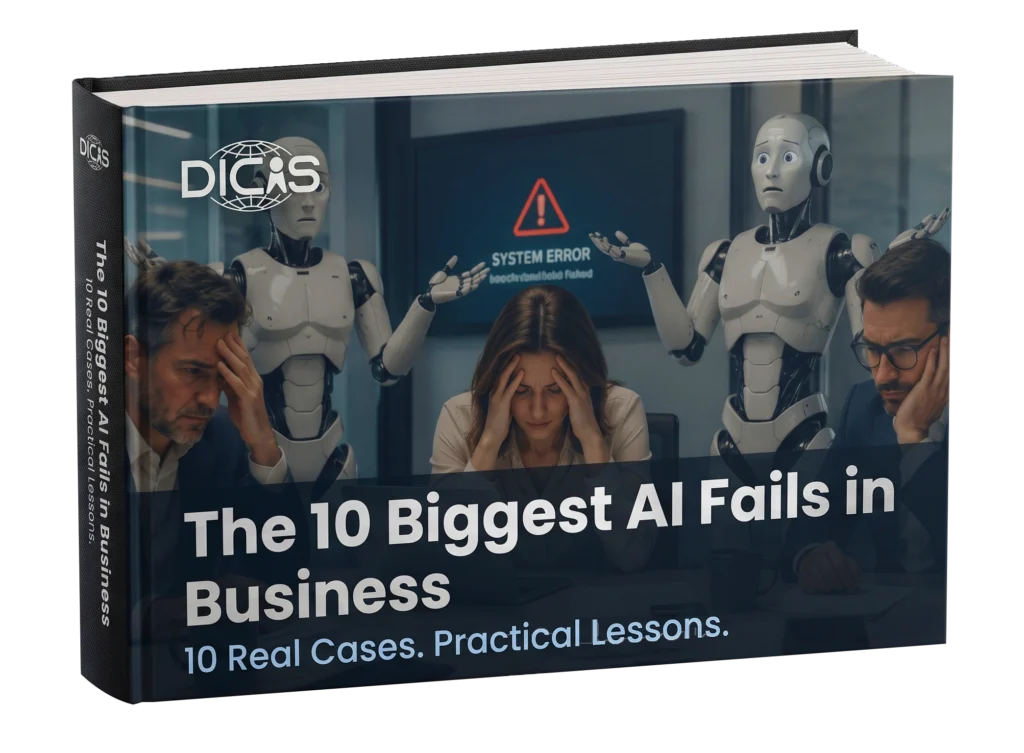
Want more? Download our free e-book: “The 10 Biggest AI Failures in Business—and What You Can Learn from Them.”
Real AI failures reveal typical errors in companies
Practice shows that many AI failures are recurring.
- KPMG had to retract a published report after several companies identified the statements contained therein as false.
- Samsung lost confidential source code because employees entered it into ChatGPT.
- Insurance companies became embroiled in disputes with repair shops because AI incorrectly assessed vehicle damage, thereby delaying repairs.
- A Chevrolet dealer made headlines worldwide after a chatbot inadvertently offered a customer a vehicle for one US dollar.
- Particularly costly was an AI deepfake fraud at the engineering firm Arup: an employee transferred approximately 25.6 million US dollars to fraudsters following a deceptively authentic video conference with a fake CFO.
These examples demonstrate that AI errors can have very different causes – from hallucinations to data leaks to manipulation by third parties. In our free e-book, you will find ten thoroughly researched, described, and analyzed AI failures. For each case, we show which lessons managing directors can draw and which concrete measures can be derived for their own company.
Successful AI deployment requires clear rules and accountability
The good news is: the problem is not artificial intelligence itself. Errors can never be completely avoided when deploying new technologies. What is decisive, therefore, is that companies establish clear rules for the use of AI. It must be defined which applications may be used, which data may be processed, when human review of decisions is required, and how risks are regularly monitored.
This is precisely why the international standard ISO 42001 was developed. It describes how companies can systematically plan, control, monitor, and continuously improve the deployment of artificial intelligence. An ISO 42001 certification establishes clear responsibilities and helps to identify risks early, effectively control them, and simultaneously strengthen the trust of customers and business partners in the responsible use of AI.
Learning from other companies’ mistakes
One can often learn more from other companies’ mistakes than from any textbook. This is precisely why we researched, described, and analyzed ten of the biggest AI failures for our free e-book “The Ten Biggest AI Failures in Companies – and What Can Be Learned from Them.” Few things demonstrate more clearly which risks exist when deploying artificial intelligence and how they can be avoided than real cases from practice. For each case, you will learn exactly what happened, why the error could occur, and which organizational weaknesses were behind it. Furthermore, you will receive concrete measures and recommendations on how to avoid similar risks in your own company. Download our e-book free of charge now and benefit from other companies’ experiences before the same mistakes happen to you.