QM tools for the implementation of ISO 9001:2026
The most important tools for your QM
QM tools help companies build a quality management system within the organization and continuously measure the effectiveness of this system. Standards such as ISO 9001:2026 describe the requirements for the quality management of companies, but do not prescribe specific QM tools. There is a reason for this. There are many different ways to achieve ISO 9001 certification. The standard is therefore very open to interpretation.
The same applies if you establish an integrated management system by combining different management systems. In this article, we present practical QM tools. We follow the guidelines of ISO 9001:2015. However, you can also apply these tools to other management systems such as ISO 27001, ISO 14001 or ISO 45001.
Overview of the use of QM tools
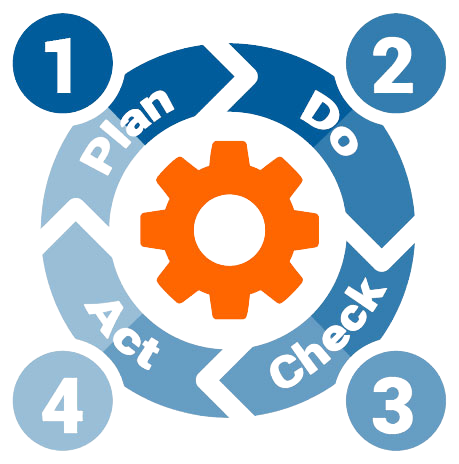
Not every QM tool fits every phase of a quality management system. Broadly speaking – as mentioned in ISO 9001:2026 – quality management can be divided into four phases that follow the so-called PDCA cycle:
- Plan: Planning and establishing a QM system
- Do: Implementation of a QM system
- Check: Monitoring effectiveness
- Act: Continuous improvement and optimization
You can find a detailed description of the PDCA cycle in our article on quality management systems.
Plan: QM tools for planning
Planning is the most intensive part of the quality management system. It involves defining goals for the company and aligning all activities accordingly. Furthermore, the interests of stakeholders should be analyzed and taken into account, and measures for customer orientation, the process-oriented approach, risk-based thinking, and the planning of processes and workflows should be established. In addition, a key performance indicator (KPI) system must be developed to establish the success of a quality management system.
The most important QM tools in this phase include:
Do: QM tools for implementation
In quality management, a decisive principle applies: if activities are well planned, processes defined, responsibilities assigned, and measurement criteria established, a company almost runs itself. At least that’s the theory. For the implementation phase, QM tools are needed that provide an overview of how well the implementation is working. And they must ensure support for employees so they can fulfill their tasks. The most important QM tools in the implementation phase therefore include:
Check: Checking if the QM system is working
One of the important requirements of ISO 9001:2026 for companies is to continuously measure all workflows and processes. On the one hand, it is checked to what extent companies have achieved their quantitative goals (for example, sales figures or units produced); on the other hand, it is checked to what extent companies have achieved their qualitative goals (their corporate objectives). Essentially, the “Check” phase is accompanied by two key questions:
- Are we doing enough? Is our output correct?
- Are we doing the right thing? Are we moving in the right direction?
QM tools for this phase take both core questions into account.
Act: QM tools for continuous improvement
The goal of a quality management system is not to avoid errors at all costs. On the contrary: errors are part of working, provided the company, department, or location draws the right conclusions from them. An important QM tool is therefore the continuous improvement process. It is presented in this phase as the central and most important QM tool.
During an ISO 9001 certification by DICIS AG, we do not check whether specific QM tools are used, but whether there is an overall structured and traceable approach to implementing the standard. The decisive factor is that your company fulfills the requirements in a practical way – not which specific methods you use. The certification is specifically tailored to the needs of smaller companies and deliberately avoids unnecessary bureaucracy.
QM tools help companies establish an effective quality management system
Anyone dealing with standards like ISO 9001:2026 for the first time will be almost overwhelmed by the complexity. The basic standard for a company’s quality management system is difficult to understand. QM tools support companies in understanding, internalizing, and putting these requirements into practice. The digital certification tool from DICIS AG integrates numerous QM tools and an AI assistant specifically tailored to small companies. This allows the entire documentation to be created easily and efficiently in a very short time with the help of artificial intelligence.